

Defining and encouraging Internet Brave behaviour
Free online safety and media literacy teaching resources for UK primary schools
In this pillar, you'll find a range of activities that define and encourage Internet Brave behaviour. The pack includes an overview of the pillar, vocabulary sheets and eight activities for ages 7–11, with versions for each age group where needed. There are also four lesson plans with guided notes, ready to teach: Lessons 5 and 6 for ages 7–9, and Lessons 12 and 13 for ages 9–11.
The activities cover topics such as what to say if pupils come across something that makes them feel uncomfortable online, what their options are – like blocking and reporting – and how to step in as an upstander when they see bullying. Pupils learn that if they're ever in doubt, the bravest thing to do is talk to a trusted adult.
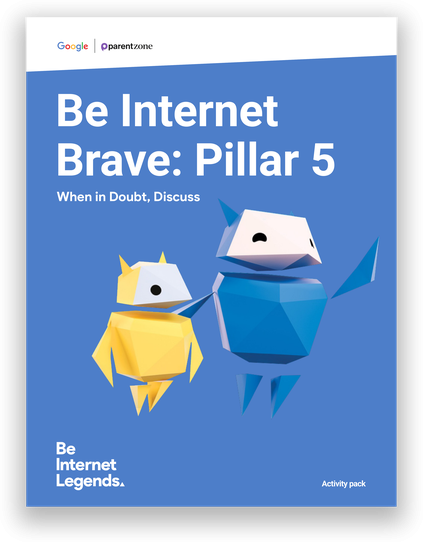
The pillar has been updated for an evolving AI world. Pupils explore what to do if they see AI-generated content that is upsetting, fake or inappropriate, such as realistic videos of people they know or admire.
Activities with a Social and Emotional Literacy focus explore the roles involved in a bullying incident and the options an upstander has. Pupils also practise what to do and say if they see something upsetting, fake or mean online.
Lesson Plans
These Be Internet Brave Lesson Plans use activities from the Pillar Activity Packs to deliver age-appropriate lessons. Each lesson plan includes objectives, outcomes, differentiations and extensions.
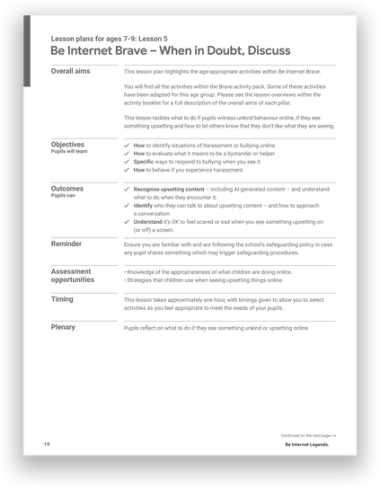
Lesson 5: Be Internet Brave
Pupils explore the roles involved in a bullying incident and how to be an upstander. They practise what to say and do when they see something upsetting online, including AI videos that look real but are fake. They also start a class list of ways to speak up.
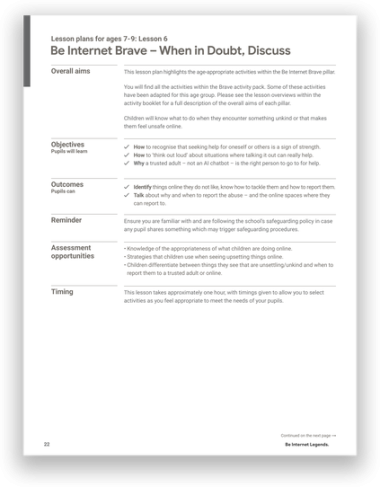
Lesson 6: Be Internet Brave
Pupils learn that asking for help is a sign of strength. They work through scenarios about when to talk to a trusted adult, and why an AI chatbot is no substitute for one. They also practise refusing upsetting content and find out how to report things online, including AI-generated content.
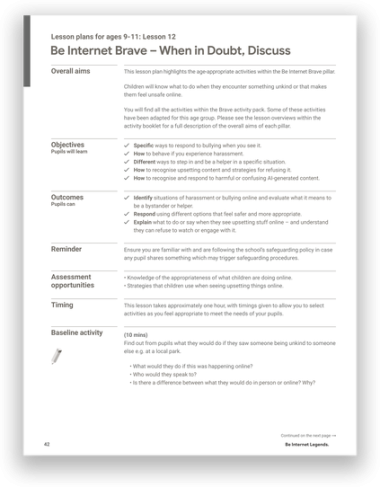
Lesson 12: Be Internet Brave
Pupils explore the roles involved in a bullying incident and choose how they'd respond as an upstander, publicly or privately. They practise identifying upsetting content, deciding when to refuse it and when to report it, including content that suggests someone could get hurt.
Lesson 13: Be Internet Brave
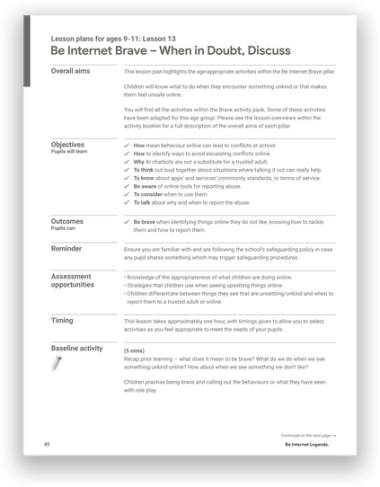
Pupils explore how to handle mean behaviour online without escalating conflict. They work through scenarios about when to get help, and find out how to report harmful content, including fake AI images and AI-generated videos.
Lesson Presentations
Download supporting interactive lessons which work with the activities included in your Pillar Packs.
All lessons are integrated with Google Classroom. Explore all lesson plans here.
Lesson 5: Be Internet Brave - When in Doubt, Discuss

Add to Google Classroom or Drive.

Share to Classroom
Lesson 6: Be Internet Brave - When in Doubt, Discuss

Add to Google Classroom or Drive.
Share to Classroom
Lesson 12: Be Internet Brave - When in Doubt, Discuss

Add to Google Classroom or Drive.
Share to Classroom
Lesson 13: Be Internet Brave - When in Doubt, Discuss

Add to Google Classroom or Drive.
Share to Classroom


