

Respect Each Other
Free online safety and media literacy teaching resources for UK primary schools
In this pillar, you'll find a range of activities that teach pupils to Respect Each Other when they're online. The pack includes an overview of the pillar, vocabulary sheets and eight activities for ages 7–11, with versions for each age group where needed. There are also three lesson plans with guided notes, ready to teach: Lessons 2 and 4 for ages 7–9, and Lesson 11 for ages 9–11.
The activities help pupils recognise and manage negative online behaviours, such as mean comments or misunderstood messages. Pupils also practise empathy and find positive ways to show kindness online.
The pillar has been updated to reflect how children connect in an AI world. Pupils think about how to show kindness and respect towards others, including when someone's creation – like a gaming avatar made with an AI picture tool – becomes the target of unkind comments.
Activities with a Media Literacy focus teach children to turn negative interactions into positive ones and to think critically to avoid conflict and misinterpretation. Activities with a Social and Emotional Literacy focus build empathy and explore ways to show kindness online.
The Kind pack is also supported by a Wellbeing pack, with additional activities that help children think about how being online makes them feel.
Lesson Plans
These Be Internet Kind Lesson Plans use activities from the Pillar Activity Packs to deliver age-appropriate lessons. Each lesson plan includes objectives, outcomes, differentiations and extensions.
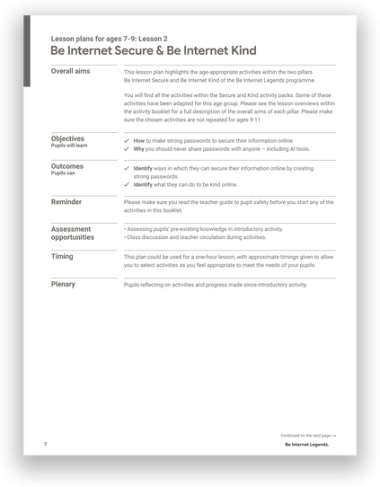
Lesson 2: Be Internet Secure & Be Internet Kind
Pupils learn how to create strong passwords and why they should never be shared, including with AI tools. They explore privacy settings and two-step verification. They also practise noticing how others might be feeling and plan their own Kindness-gram to show kindness to someone in their life.
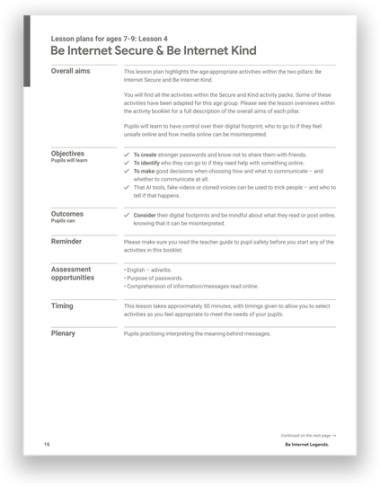
Lesson 4: Be Internet Secure & Be Internet Kind
Pupils explore what can happen when passwords are shared and discuss who to tell if they feel unsafe online, including if an AI tool, fake video or cloned voice tricks them. They also think about how to stand up for others and practise reading messages in different moods to see how easily they can be misread.
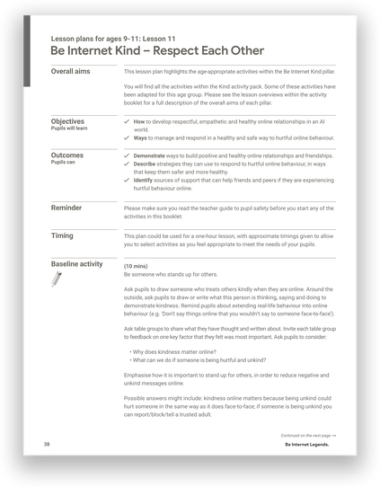
Lesson 11: Be Internet Kind
Pupils practise empathy by working out how people might be feeling in online scenarios. They come up with ways to show kindness, including towards a friend whose AI-designed gaming avatar receives unkind comments. They also read messages in different tones to see how easily they can be misunderstood.
Lesson Presentations
Download supporting interactive lessons which work with the activities included in your Pillar Packs.
All lessons are integrated with Google Classroom. Explore all lesson plans here.
Lesson 2: Be Internet Secure & Be Internet Kind

Add to Google Classroom or Drive.

Share to Classroom
Lesson 4: Be Internet Secure & Be Internet Kind

Add to Google Classroom or Drive.
Share to Classroom
Lesson 11: Be Internet Kind - Respect Each Other

Add to Google Classroom or Drive.
Share to Classroom


