Building AI confidence in the classroom
How Experience AI is helping educators develop AI literacy
Artificial intelligence is part of everyday life for young people. Teaching students what AI is, how it works, and why it should be used responsibly remains, however, a challenge.
For Hayley McKechnie, a computing lead at a school in the East of England, training through the Experience AI programme has been central to building confidence, both her own and that of colleagues, when teaching AI in the classroom.
Through professional development, practical classroom materials and a strong focus on ethics, the programme – which was co-developed by the Raspberry Pi Foundation and Google DeepMind – has helped her bring AI to life in a way that feels accessible, age-appropriate and responsible.
Building confidence through training
Hayley began her AI education journey by attending training sessions to strengthen her own understanding of artificial intelligence. “This was an important step,” she says,” because many teachers are learning about AI alongside their students.”
“The training really helped me understand how AI actually works. That is so important because if you are not confident in yourself, it is very hard to explain it clearly to children.”
Initially, Hayley trialled one or two lessons with her students, carefully introducing concepts as AI tools became more visible in everyday life. As her confidence grew, she expanded her use of the materials and this year plans to deliver the full six-week unit as a dedicated part of the computing curriculum.
“What I like is how clear and straightforward the programme is,” she says. “The training makes it easy for teachers to pick up while still giving students a solid foundation in how AI works.”
Before starting AI lessons, Hayley grounds learning in familiar examples – such as voice assistants, search engines and design tools. This helps students recognise that AI is not abstract but already embedded in their lives.
Making ethics central
A key strength of the Experience AI training, she believes, is its strong emphasis on ethics and critical thinking. Rather than presenting AI as something to trust automatically, the programme supports teachers in encouraging students to question and evaluate the technology they encounter.
“We want students to understand that AI can be helpful but it is not infallible and it should not be relied on blindly.”
She recalls showing students how AI-generated search results can sometimes be inaccurate. This is a practical way to demonstrate why human judgement still matters. These discussions help students understand both the potential and the limitations of AI, reinforcing the idea that technology should support thinking rather than replace it.
Learning alongside colleagues
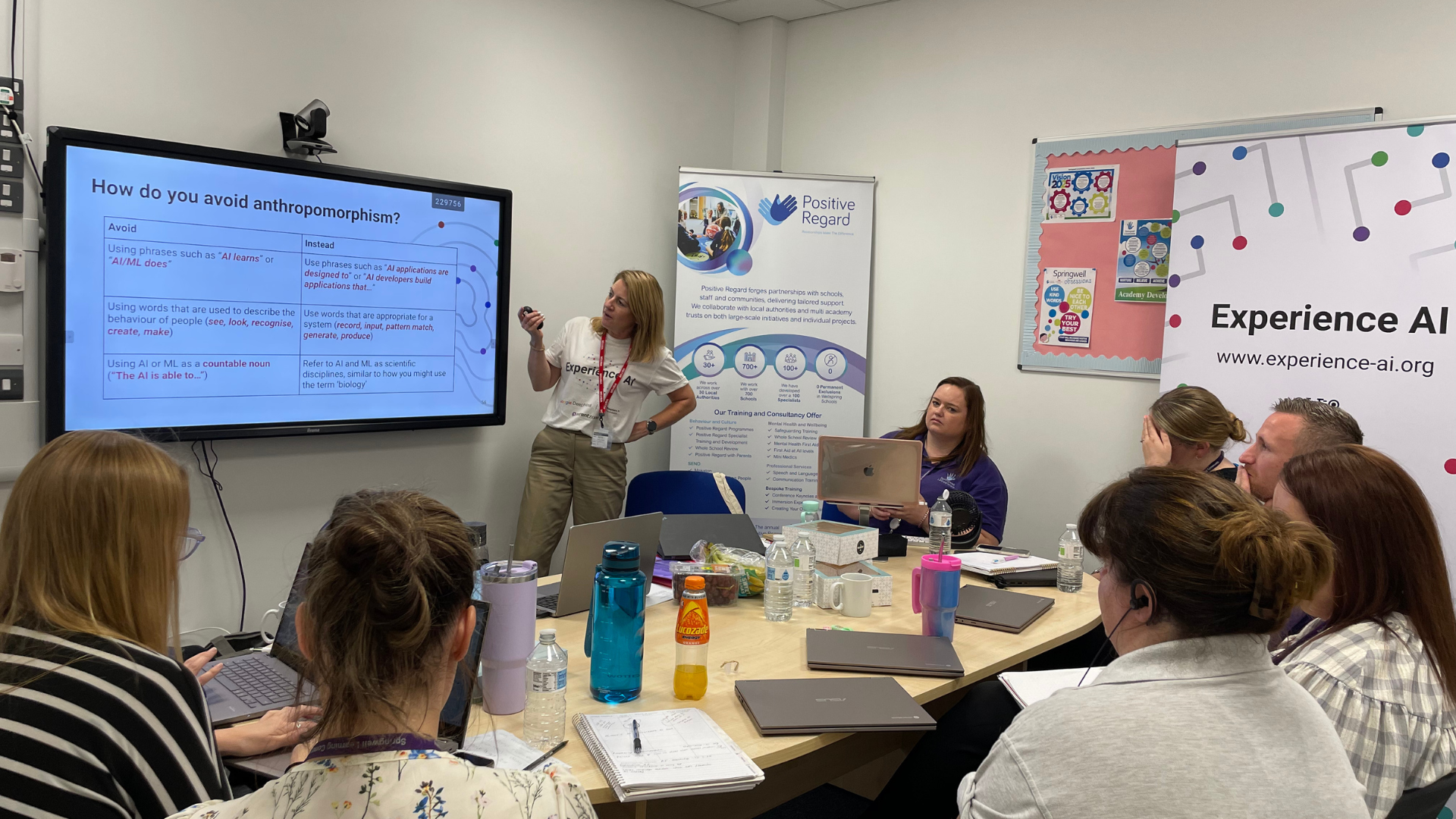
Beyond her own classroom, Hayley has used Experience AI training to support other teachers. As part of her role coordinating computing across schools in her region, she organised a cluster meeting for 20 computing leads from schools across Essex, Suffolk and Norfolk.
The session brought teachers together to share experiences, explore how AI could be introduced in age-appropriate ways, and discuss how to embed ethical considerations across the curriculum. A Parent Zone trainer delivered the session and helped deepen the group’s understanding.
“Many computing teachers are still getting to grips with AI themselves,” Hayley says. “The training helped me feel more confident, and that confidence is something I wanted to pass on to others.”